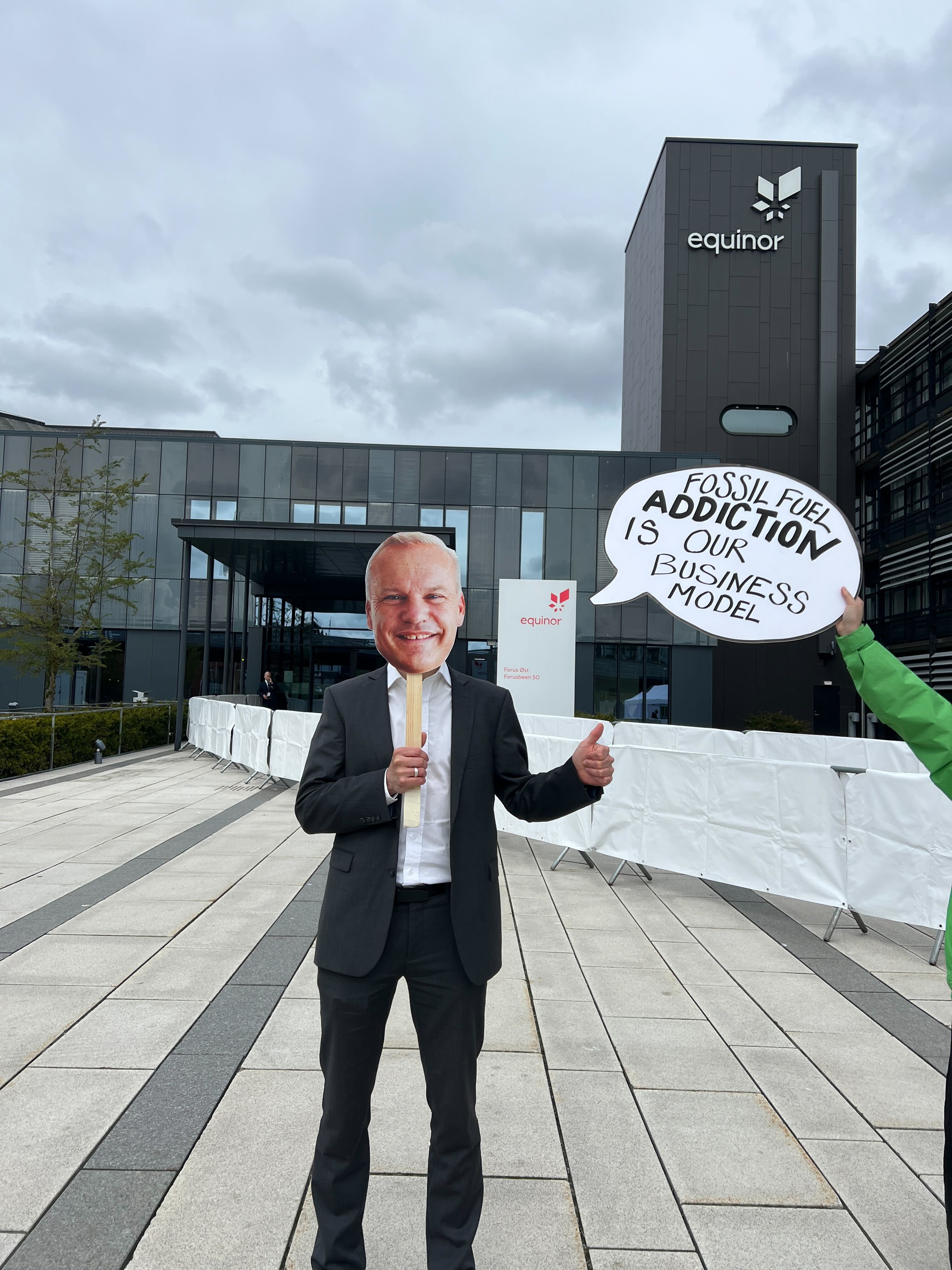
On May 12, Equinor held its 2026 annual general meeting, where shareholders voted on proposals concerning the company’s climate targets, oil and gas expansion, and continued exploration in the Norwegian Barents Sea. The votes showed concern among minority shareholders over Equinor’s retreat from renewable energy ambitions and its continued focus on fossil fuels.
Shareholders challenge Equinor’s fossil fuel strategy
Every shareholder has the right to submit proposals to the AGM, which are then voted on by fellow shareholders. Greenpeace owns one share in Equinor, which is enough to give voting rights and the right to submit proposals. This year, several proposals were submitted by WWF, Greenpeace, and other minority shareholders.
Over the past few years, Equinor has repeatedly scaled back its energy transition ambitions. The company is now moving away from its stated ambition to become a broad energy company, and instead appears increasingly focused on continuing as an oil and gas producer.
This was the focus of Greenpeace’s shareholder proposal, which called on Equinor to set targets and operate in line with international climate commitments and the Paris Agreement.
The proposal was supported by 16.8 of the non-governmental votes, which shows that giving up on the green transition is not popular among Equinor shareholders
The Norwegian state owns 78% of Equinor, while the Government Pension Fund Norway, managed by Folketrygdfondet, owns around 4%.
WWF proposal targets Barents Sea oil and gas risk
WWF submitted a shareholder proposal asking Equinor to publish a coherent assessment of the risks linked to continued exploration and expansion in the Norwegian Barents Sea.
The proposal builds on a recent publication assessing the economic risks of new oil and gas investments in the Barents Sea. The report finds that oil and gas projects in the Arctic carry high financial risk and low profitability.The proposal gained 10% of the non-state votes, a significant share.
The Arctic has less developed infrastructure than more mature oil and gas regions, and cost overruns have historically been high. This means Arctic oil and gas projects require much higher oil and gas prices to be profitable.
Arctic oil drilling also poses serious risks to nature. An oil spill in this fragile and pristine environment could have severe and long-lasting consequences.
All shareholder proposal and Equinor´s response can be downloaded from Equinor's own page.
Equinor scales back renewable energy ambitions
When Statoil changed its name to Equinor in 2018, the company presented itself as an energy company in transition: from an oil and gas company into a broad energy company.
Eight years later, more than 99% of Equinor’s energy production still comes from fossil fuels, and the company invests four times more in oil and gas than in renewable energy.
Equinor has also been heavily criticised for scaling back its climate targets and renewable energy ambitions. Recently, the company removed its ambition to direct 50% of investments towards renewable energy and low-carbon solutions by 2030. It also reduced its renewable energy production target from 12–16 GW to 10–12 GW by 2030.
Read more about Paris-alignment
Climate risk is financial risk
The best available science shows that there is no room for new oil and gas projects if the world is to limit global warming to 1.5°C. Still, Equinor continues to search for more oil and gas.
Climate risk is increasingly financial risk. Investor groups have warned that Equinor’s strategy exposes shareholders to transition risk, stranded assets, and weaker long-term returns if the company continues to prioritise oil and gas expansion over Paris-aligned transition planning.
Equinor’s shareholders should not accept a strategy that locks the company deeper into fossil fuels at a time when the world needs a rapid and just energy transition.
Read more about Equinor and financial risk