.jpg)
Natural gas and Equinor
Norway is one of Europe’s largest suppliers of natural gas, and Equinor is Norway’s biggest gas producer. At the same time, EU climate policy points toward a sharp decline in gas demand. Despite this, Equinor continues to invest in new oil and gas production, risking more emissions, and new fossil fuel infrastructure that may not be needed in a Paris-aligned energy transition. This is why natural gas matters:
- Natural gas is fossil methane gas, not renewable energy.
- Burning gas releases CO₂, while leaks across the supply chain release methane.
- EU climate policy requires a sharp reduction in fossil fuel use.
- New gas fields risk creating emissions and infrastructure that are incompatible with a Paris-aligned transition.
- Equinor remains heavily dependent on oil and gas despite presenting itself as a company in transition.
What is natural gas made of?
Natural gas is a fossil fuel formed from organic matter buried beneath the Earth’s surface over millions of years. It consists mainly of methane, but can also contain other hydrocarbons and gases.
- Pipeline gas, often called dry gas, mainly consists of methane and is transported through pipelines. A significant portion of the EU's gas consumption consists of dry gas imported from countries such as Norway.
- Wet gas contains methane as well as other components such as ethane, propane and butane. These can be separated and sold as individual products.
- Liquefied natural gas, or LNG, is methane gas cooled to around -162°C so that it becomes liquid. LNG is transported by ship and sold on the global market.
- Shale gas is gas trapped in shale rock. It is chemically similar to other fossil gas but is extracted using different methods, often including hydraulic fracturing.
Despite the word “natural,” natural gas is not clean energy. It is fossil methane gas.
Is natural gas green or a fossil fuel?
Natural gas is a fossil fuel, not a green energy source.
Gas produces less CO₂ than coal when burned for the same amount of energy, but this does not make it climate-friendly. The climate impact of gas depends on the full supply chain: extraction, processing, transport, storage and combustion. Gas combustion is responsible for 21% of global GHG emissions. To meet the goals of the Paris Agreement, the world must reduce both the supply and demand of fossil fuels. This includes natural gas.
When gas companies discuss emissions from gas, they often focus on the CO₂ released when gas is burned. But the full climate impact also includes methane that escapes before the gas reaches the consumer. Because methane is a powerful greenhouse gas, even small leaks can have a large climate effect. This is especially important for countries and companies that export large volumes of gas, such as Norway and Equinor.
Blog: 5 reasons why ‘natural’ (fossil) gas is no better than oil and coal
Will EU demand for natural gas decline?
The EU has a legally binding goal of climate neutrality by 2050. It has also set intermediate climate targets, including reducing net greenhouse gas emissions by at least 55% by 2030 and by 90% by 2040 compared with 1990 levels.
EU gas demand is expected to decline as the bloc implements climate policy, expands renewable energy, improves energy efficiency and electrifies industry, heating and transport. These new policies send clear signals to natural gas producers that the EU is committed to reducing its dependence on fossil fuels, whether it is supplied from Russia, Norway or the US. As a result, the EU’s reliance on natural gas is forecasted to be drastically reduced in the coming years.
This creates a serious problem for new gas projects. Gas fields approved today may only start producing years from now. By the time they are fully operational, EU demand may already be falling sharply.
Blog: Read more about EUs forecasted natural gas decline
Where does the EU import natural gas from?
The EU imports gas from several regions, including Norway, the United States, North Africa and Qatar. Since Russia’s full-scale invasion of Ukraine, the EU has reduced its dependence on Russian gas and increased imports from other suppliers.
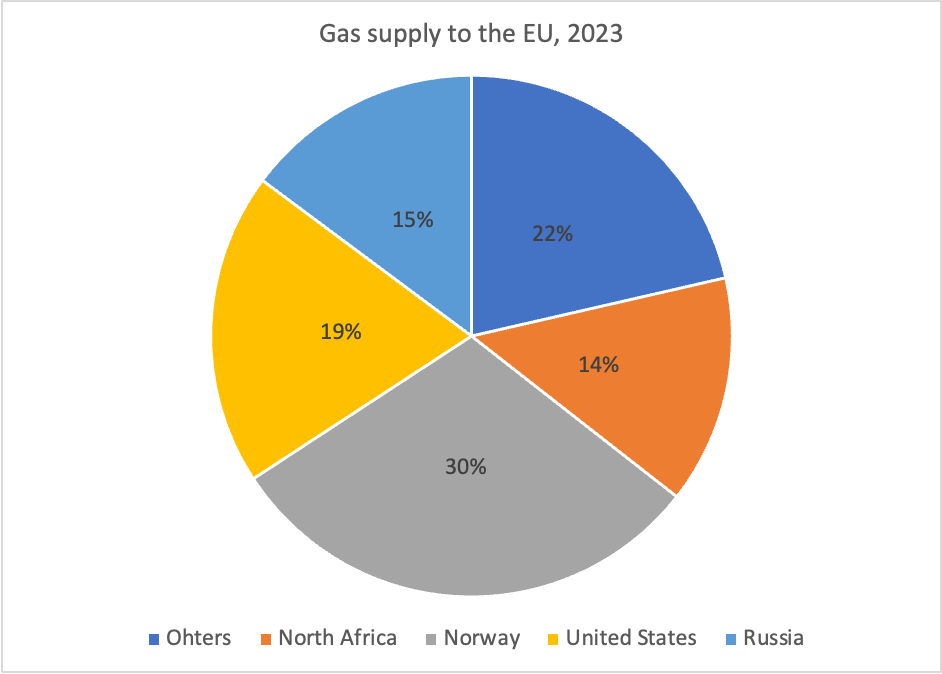
Norway has become one of the most important gas suppliers to Europe. A large share of Norwegian gas is transported by pipeline to the EU and the UK. This shift has strengthened Norway’s short-term role in European energy security. But short-term energy security does not justify long-term fossil fuel expansion. The EU’s climate targets point toward lower gas demand, not higher gas demand.
Norway’s role as a major gas supplier to Europe is often used to defend continued oil and gas exploration. Norwegian officials and the petroleum industry argue that new activity on the Norwegian continental shelf is needed to secure Europe’s energy supply. However, this argument rests on a weak long-term assumption. EU gas demand is expected to fall sharply from 2030 onwards — years before many new Norwegian discoveries would start producing. Exploration decisions made today therefore risk locking Norway into new fossil fuel supply for a market that is already set to decline.
How much natural gas does Equinor sell to Europe?
Equinor is Norway’s largest gas producer and one of Europe’s major gas suppliers. Most of Equinor´s gas is exported by pipeline to the EU and the UK, with Norway's share covering nearly 30% of the gas market in the EU
In 2025, Equinor reported gas sales of 67.4 billion cubic metres of gas. When burned, this gas causes large downstream emissions corresponding to 134 million tons of CO2, or nearly 3 times the emission from Norwegian territory. These are known as scope 3 emissions: the emissions that occur when customers use the oil and gas that Equinor sells.
This is why Equinor’s climate responsibility cannot be assessed only by looking at emissions from its own operations. The largest climate impact comes when the fossil fuels it sells are burned. Since most of Equinor’s climate impact comes from the use of the fossil fuels it sells, a credible transition strategy cannot focus only on reducing operational emissions. It must also involve reducing future oil and gas production. Continued investment in new fields moves the company in the opposite direction.
However, the Equinor continues to invest in fossil fuel production and infrastructure. In June 2026, Equinor and its partners announced a new investment of more than NOK 4 billion in the Troll field to increase gas production from Norway’s largest offshore gas resource. Globally, Equinor is still pursuing the Bay du Nord project in Canada despite major local opposition and uncertain economic conditions.
Equinor presents itself as a company in transition, but its strategy remains heavily dependent on oil and gas.
Equinor’s lobbying and the gas bridge fuel argument
The oil and gas industry often presents natural gas as a “bridge fuel” between coal and renewable energy. The argument is that gas can reduce emissions in the short term by replacing coal, while renewable energy is scaled up.
But this argument is increasingly weak. A recent study by Bård Harstad at Stanford University and Katinka Holtsmark at the University of Oslo shows that gas can reduce emissions in the short term, but increase emissions in the long term if it slows investment in renewable energy. In other words, gas may look like a short-term substitute for coal, but it can become a long-term competitor to renewables.
This means that gas does not only risk adding emissions from new fossil fuel production. It can also slow climate progress by locking energy systems into fossil infrastructure. New gas pipelines, LNG terminals, power plants and production facilities can operate for decades. Once built, companies have a financial incentive to keep them running for as long as possible.
This creates carbon lock-in. Gas infrastructure can delay the shift to renewable energy, electrification and energy efficiency. It can also crowd out investment that should go to clean energy instead.
Equinor and other oil and gas companies use the bridge fuel argument to defend continued gas production. But Europe’s climate goals require a managed decline in fossil fuel use, not a new wave of gas development. If gas expansion delays renewable energy, it is not a bridge to a clean energy system. It is a barrier to one.
Natural gas is not a climate solution
Natural gas is a fossil fuel. It emits CO₂ when burned. It can leak methane before it reaches consumers. It requires infrastructure that can lock countries into fossil fuel dependence for decades.
For Europe, the path to climate security is lower gas demand, more renewable energy, more electrification and better energy efficiency. For Equinor, a credible transition would mean reducing dependence on oil and gas rather than developing new fossil fuel supply.